Posts

The Unthinkable

The plan was to get up early and go birdwatching in the forest near the village. Perhaps we'd see Victoria's Astrapia, a rare bird of paradise known to frequent the Papuan Highlands at this altitude. The getting up early bit went according to plan. As I relieve myself in the outhouse, a square hole in the ground with a ten-foot pit beneath, my wallet (containing my passport, credit cards, cash in several currencies, travel insurance, and flight tickets) slides off my belt. I hear a resounding plop, then silence. Rapidly buckling up my shorts, I turn around, drop to my knees, and thrust my head into the hole. By the light of my head-lamp, I can see my wallet, floating like a baby turtle in a pond of slurry ten feet down. Shit. I get to my feet and scramble back up the mud steps to the hut where we're staying and hunt for a stick. There are sugar canes of suitable length, but these are bendy. I find a four-foot stick and reject that, too. I need two long, sturdy sticks. My ...

Welcome to Maikmol

Image
We stop dead in our tracks. Two men are sprinting towards us, one priming an arrow on his bow, the other brandishing a spear. They are splashed from head to foot in white war-paint and are naked but for the leaves covering their genitals. They brake in front of us, and, scowling and hissing, start lunging with their weapons. Nadya and I take a step backwards. Two women, one wearing a parrot-feather coronet and waving a bunch of marigolds, are hard on their heels. As the scouts retreat, we advance tentatively down the path to the village and hear singing voices. Some fifty people have gathered at the gate, a temporary construction of bamboo decorated with flowers, and they are of all ages and also plastered in white. A little boy takes two steps forward and holds up a sign. "Welcome to Maikmol." This is the fourth day of our first hike in the Highlands of Papua New Guinea. Our party is larger than expected. Paul Riss, the guide I communicated with via email from Australia...

Betel Mania

The importance of betel nut in PNG, especially on the Sepik, cannot be overstated. As Mathilda, the woman who hosted us in Korogu village, mentioned, betel nut is the first thing people exchange and it is used to cement relationships. How often we have seen people giving and receiving betel nuts. Without realizing it at first, our relationships with people changed and deepened when we started buying betel nuts for our travel companions and hosts. People would say: "Gut pla pasim"and "Em meri/man gut pasim," which mean "They are kind people" and "She/he is a kind woman/man". Betel is used to settle disputes or make amends. One is expected to give a chicken, a branch of betel nuts and 10 or 20 kinas to settle a personal issue, but, if the dispute is between families, the cost is higher and a pig and a bushel of betel are expected with money. Betel is also an important part of the funeral ritual. Big branches of betel nuts are hung in the ...

Scarface

Image
"... He's closer to a ton than half a ton, but we don't get to put him on a set of scales, so that is just an educated guess... We had one of our smaller tour boats out the other day, and Scarface was swimming alongside, and he was well over haaalf the length of the boat, which, ladies and gentlemen, makes him fiiiive metres long." It was a surprise to me that, in the five weeks Nadya and I spent paddling down the Sepik and exploring its backwaters in Papua New Guinea, we only once saw a crocodile (that wasn't in captivity): a log of a creature, basking on a mudbank on the far side of the river. Yet we heard of crocodiles and saw images of them almost every day. A skull of a monster crocodile resided in the Middle Sepik's oldest and most venerated Haus Tamboran in Palembai. Carvings of crocodiles decorated the supporting pillars of all spirit houses. Our hired paddlers talked of going on croc hunts at night, and crocodile steak was on the menu for dinner whe...

Day 20: Haus Tamborans

Image
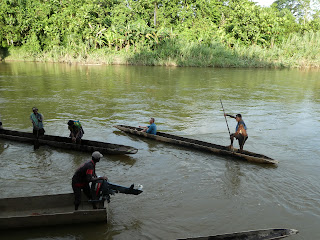
Papua New Guineans call their country the "Land of the Unexpected." I never would have thought eight days ago, when a tropical storm ended our hopes of paddling to Kaminabit, that we would relaunch our canoeing expedition for a third time. But here we are, Nadya with a short paddle, me with a long one, digging into the muddy, brown river, bound for Angoram, largest and last significant village on the Lower Sepik. Our company for the final three-day leg of our voyage is Cyril Tara, an exuberant tour guide; Nick Lumat, wood carver and Seventh-Day Adventist; and Chris Tupma, carpenter and canoe maker. Cyril's canoe is a fine specimen: no leaks and plenty of room for four people, their bags, three plump papayas, a plastic bin of mugs and plates, even two wicker chairs with backs and armrests. With a 45 HP outboard engine weighing down the stern, the paddling will be as hard as before, but Nadya and I have n ever had it so good. For the first time, I can stand up in a single...

Bartering at Korogu

Image
"This is my cousin-sister" Mathilda says waving at a woman in her canoe. "We sit next to each other at the market". As we cross the lake, we greet more than a dozen other 'market mothers' from Korogu. Our host, Mathilda, is one of them and has her bag of fish to exchange with women from the inland villages of Selai, Aulimbit, Kosingbi, and Yamuk. If she is lucky, she will sell some and make a small profit. The barter system is well established in Korogu, explains Mathilda. "First we need to buy betel nut and look at the garden food". For a good hour, not much seems to be happening. Market mothers from inland continue to arrive and display the garden food items. The women carrying fish sit in their respective areas but don't display their fish yet. People with money in their hands buy betel, sago, vegetables and fruits. Suddenly, as if someone had rung a bell, women display their fresh and dried fish. A few people buy some and then the barte...

Day 12: Waves and Whirlpools

Image
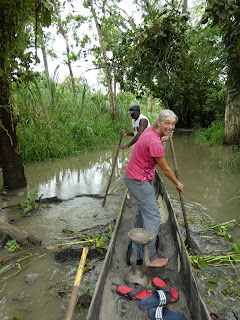
"It's no good, Tony. Water's coming in again at the front. I have to stop and bail." "Can't stop here! Waves are too big. Let's try going faster, get over to the far bank where the water's calmer." "No. NO! Stop paddling! STOP! It's coming in over the side now." "Shit. SHIT! Knew in Pagwi the waterline was too low. Can't even carry our bags on this frigging thing!" Nadya tosses her paddle aside and starts bailing feverishly with half a plastic Coca-Cola bottle, but it is too late. If only our pirogues were equal to those we bought in the Upper Sepik. Roped together, the two had formed a sturdy raft that could carry six people with bags, bananas, and coconuts. But in Pagwi, the hub of the Middle Sepik, there had been no choice. Most people got about by motor-canoe. We could only find for sale a two-man fishing pirogue in poor shape and another suitable for a five-year-old. Maybe if we joined these, we might cont...

A la source

Image
Ce matin, on est alle visiter une source thermale sur l'ile de Kairiru pres de Wewak. La source emane d'un rocher sur le bord de la plage. L'eau est suffisamment chaude pour y faire cuire un oeuf et c'est en plein ce qu'on a fait! On est parti de l'ile de Yuo avec notre hote, Tony, et ses trois jeunes freres King, Samuel et le petit Mark. 1er arret: la mission catholique St-John. Un vieux missionnaire de la Nouvelle Zelande nous a vendu des oeufs frais avec en prime une jasettes dans la chambre froide (quel bonheur! J'y serais reste l'avant-midi complet). 2e arret: un camp de base a la pointe ouest de l'ile. De la, on a emprunte un sentier pour se rendre dans la baie situee de l'autre cote de la pointe la ou se trouve la source thermale. La source emet des jets de vapeur et il y a une petite crevasse dans le roc just assez grande pour y deposer 1/2 douzaine d'oeufs. Avant de plonger nos oeufs dans le chaudron naturel, on les a enveloppes dan...

Day 7: Yanak, the Sorceror

Today, our paddlers are two brawny Papuans called Anton and Negatimus. I would like them to accompany us all the way to Kubkain, a full day's paddle away, but they don't wish to go that far. Our raft has become wider. They have tethered their pirogue to ours. When we arrive at Oum, in about five hours' time, they will detach it and paddle home. They expect to get home after dark, and Anton has brought along his crocodile catcher: a long bamboo spear with a barbed metal spike in the end. Crocs are abundant, he says, but nocturnal (we have only spotted one so far, a two-metre-long beast asleep on a mud-bank). A good hide sells for 500 kina, apparently. It is a tricky day for me. Yesterday, I drank too quickly from a creek feeding the Sepik, not allowing our "Pristine" purification tabs to do their work. Now I have diarrhea. From time to time, I have to strip down to my undies, make apologetic sounds, and slide off our plank into the river. Nadya captures my facial...

Day 3: Baiwei and Tipas

After the rain, the sun is brutal, reflecting off the surface of the water. At midday, there is no escaping its intensity (has to be 35°C). I wear my wide-brimmed hat, my long-sleeved shirt with the collar turned up, and, when I am not paddling, cover my knees with my waterproof jacket. Boot socks protect my ankles, which are already dotted with angry heat spots. Nadya hides beneath her Tilley hat. We are on the Upper Sepik, yet the river is already 200 metres wide and swings lazily from left to right: a chocolate brown snake uncoiling in an easterly direction. Our progress seems laboured, particularly when we are paddling midstream. But, go close to one bank or the other, and we feel the surge of the current and hear water breaking as it washes over submerged logs. Having two pirogues tied together does not hamper our progress now that we have four paddles. Our students are good at finding the swiftest course; their technique is to paddle fast to cross "dead water" and the...

Au bout du monde

Depuis deux semaines, j'ai l'impression d'etre au bout du monde. Je ne m'etais jamais senti si loin, meme au Bouthan. Dans la region de la riviere Sepik, on se sent dans une zone frontiere la ou la nature est toute puissante, ou les routes sont des sentiers de terre battue, ou la riviere est le chemin principal et ou plusieurs villages ne sont accessibles que par avions de brousse. La ou il n'y a pas de banques, ni de ATM, ni d'internet et ou meme le lien cellulaire est rare. Vanimo, Maprik et Wewak sont des villes frontiere ou la princiale activite semble etre le commerce avec leur 'trading stores'. Les villageois viennent vendre leur poisson fume, peaux de crocodiles, or et vanille et, avant de retourner dans leurs villages, ils font le plein de nourriture, d'essence et de quelques marchandises.  Il faut dire que la jungle et la riviere/mer leur fournissent presque tout ce dont ils ont besoin pour se loger et se nourrir. Tous sont chasseurs-pecheur...

Slowly down the Sepik

Image
"Apinun. Yu stap gut?" We arrive at the last stilt hut in the village late afternoon and shake hands with a lean, muscular man with a shaven head and triangular beard. The four high school students accompanying us have already told him what we want. Yanking a long-shafted paddle out of the dirt, he indicates that we should follow him down a dirt path. Naked boys fling themselves off the two-metre-high river bank and shriek as their bodies smack the churning, muddy waters below. One plasters himself from head to foot in mud before coming to look us over. The Dio, a tributary of the Sepik River, is about fifteen metres wide and bordered by tall grasses and a rich tangle of vine-throttled trees. I see seven-metre-long dug-outs with outboard engines nestled against the near bank. Not what we are after. The man invites us to shed our backpacks, sit down on a log, and wait a while. Young mothers in flowery dresses and threadbare shirts, carrying babies on their hips, join us;...

Orang Papua 2

Wa, wa, wa, wa, wa, wa... une vieille femme me serre les avants bras et me regarde droit dans les yeux. Je lui repond, un peu hesitante, de la meme facon en soutenant son regard. Elle me sourit a pleines dents. Les liens sont tisses serres chez les Papous de la vallee de la Baliem. Qu'ils soient Dani ou Yali, ils se saluent tous chaleureusement lorsqu'ils se croisent sur les sentiers. Une poignee de main et un bonjour sont pratique courante. Salamat pagi le matin, siang l'apres-midi, sore en fin de journee et malam le soir. D'autres se saluent en dialecte local: wa, ya ou encore neroup specifiquement pour les femmes, naya pour les hommes, nopase pour les aines et naosa pour les ainees. Cette differentiation des genres peut mener a confusion comme ce fut le cas lors de notre passage au village de Yuarima. Invites a la pendaison de cremaillere du nouveau 'honai' (maison traditionelle) de l'oncle de Kanak, notre guide, j'ai bien fait rire les hommes quand ...

Bark-string Bags & Penis Gourds

Image
Exhausted after nine hours of walking with our backpacks, we descend to the Kali Mugi, a tributary of the Baliem river, and enter the village of Syokosimo. Kanak knows of a place we might stay for the night. Soaked in sweat, boots tarred in mud, Nadya and I look forward to a dip mandi and "teh manis," a bucket wash and a cup of sweet black tea. Shadowed by kids yelling "Gula! Gula!" (Candies! Candies!), we arrive at the door of a "honai," a traditional hut with a grass roof. Smoke billows from the doorway. "Wa, wa! Wa, wa!" A skinny woman in a red headscarf and grimy pleated skirt seizes our hands and shakes them. A man - her husband perhaps - lays out some axes, resembling adzes, on the ground for our inspection. An older man, wearing nothing but a coronet of black feathers and a penis gourd, drifts over. We are the centre of attention. It is Day 4 of our trek through Dani country in the central highlands of West Papua. Our guide is a diminu...

Napoleon

The motorized outrigger canoe drops anchor, and Nadya and I dive over the side with our snorkels. "Sampai jumpa lagi," shouts helmsman Erick Farwas, the Papuan hosting us on Pulau Wundi, one of 36 islands in the Padaido atoll 500 kilometres west of Jayapura. Catch you later. The current carries us along the reef and into the company of a thousand fish: yellow and black Moorish Idols, rainbow Parrotfish nipping at spiky coral fans, Surgeon and Unicorn fish nudging along in shoals, Clown fish gawping at us from forests of sea anemones, a two-metre black-tip reef shark patrolling the depths. From time to time, we dive and search the folds of brain coral for the speckled head of a Moray eel or poke our noses under a ledge for zebra-striped lobsters waving their antennae. I wonder what the fish make of us. Blundering, finless aberrations hardly to be taken seriously? A school of barracuda cruises by unperturbed. In the Raja Ampat archipelago, West Papua's prime dive spot...

Orang Papua

Image
La fierte des gens de la Papouasie orientale creve les yeux. Quand on leur demande d'ou ils viennent, ils n'hesitent pas a dire qu'ils sont des "orang Papua", des papous. Ils portent des chandails et des sacs "I love Papua", mais ne cherchez pas un drapeau Papou car ils sont interdits sous peine d'emprisonnement. Dans la region de Manokwari, les gens ont beaucoup soufferts a cause de leur soutien au mouvement pro-independence. Des villages entiers ont ete severement punis pour leur appui. Les parents d'une de nos connaissances ont evite la mort en se cachant dans la foret lors d'un raid de l'armee dans leur village lorsqu'ils etaient jeunes et ils n'ont pas oublie. Aujourd'hui, ils se tiennent loin du mouvement et ils ne sont pas les seuls. Malgre tout, ils restent fiers de leurs racines et semblent maintenir leurs langues et leurs traditions. Depuis notre arrivee, on a visite trois regions (Raja Ampat, les monts Arfak et Bi...

Birds of Paradise

Image
Nadya and I sit alone in the dark. We're in a leafy hide, faces pressed to 'portholes' punched in the side. Our view is of a clearing and of a pandanus cone balanced on a tripod of sticks. It is a massive fruit, bright red and phallic, twice the length and girth of an English cucumber. Our quarry is 19cm long with a lumped brown head, green belly, yellow back and wings, and blue legs. Jutting from its rear are two wires resembling coiled springs. This is the male Magnificent Bird of Paradise, and, according to Pratt and Beehler, it utters "a rapid rolling series of -8 loud, downslurred churr notes, growing louder and more insistent" (Birds of New Guinea). We have been in New Guinea a month now, choosing to discover Keptang Burung, the Bird's Head peninsula, at the extreme western end (of the Indonesian half) first. One of our motives for visiting Papua was to behold the unique and quixotic Birds of Paradise, of which Pratt and Beehler list twenty-nine. The...
Almost ten years after our two years in Bhutan, we are ready for a new adventure. This time, we're headed to the island of New Guinea and hope to spend some time exploring both the Indonesian and Papua New Guinean sides of the island. Our first stop though is Singapore to see good friends first! Apres bientot dix depuis notre retour du Boutan, on repart a l'aventure. Notre but: explorer l'ile de la Nouvelle Guinee. On va d'abord visiter la partie occidentale qui est Indonesienne puis on va traverser du cote de la Papouasie Nouvelle Guinee. A bientot,