Posts

Betel Mania

The importance of betel nut in PNG, especially on the Sepik, cannot be overstated. As Mathilda, the woman who hosted us in Korogu village, mentioned, betel nut is the first thing people exchange and it is used to cement relationships. How often we have seen people giving and receiving betel nuts. Without realizing it at first, our relationships with people changed and deepened when we started buying betel nuts for our travel companions and hosts. People would say: "Gut pla pasim"and "Em meri/man gut pasim," which mean "They are kind people" and "She/he is a kind woman/man". Betel is used to settle disputes or make amends. One is expected to give a chicken, a branch of betel nuts and 10 or 20 kinas to settle a personal issue, but, if the dispute is between families, the cost is higher and a pig and a bushel of betel are expected with money. Betel is also an important part of the funeral ritual. Big branches of betel nuts are hung in the ...

Scarface

Image
"... He's closer to a ton than half a ton, but we don't get to put him on a set of scales, so that is just an educated guess... We had one of our smaller tour boats out the other day, and Scarface was swimming alongside, and he was well over haaalf the length of the boat, which, ladies and gentlemen, makes him fiiiive metres long." It was a surprise to me that, in the five weeks Nadya and I spent paddling down the Sepik and exploring its backwaters in Papua New Guinea, we only once saw a crocodile (that wasn't in captivity): a log of a creature, basking on a mudbank on the far side of the river. Yet we heard of crocodiles and saw images of them almost every day. A skull of a monster crocodile resided in the Middle Sepik's oldest and most venerated Haus Tamboran in Palembai. Carvings of crocodiles decorated the supporting pillars of all spirit houses. Our hired paddlers talked of going on croc hunts at night, and crocodile steak was on the menu for dinner whe...

Day 20: Haus Tamborans

Image
Papua New Guineans call their country the "Land of the Unexpected." I never would have thought eight days ago, when a tropical storm ended our hopes of paddling to Kaminabit, that we would relaunch our canoeing expedition for a third time. But here we are, Nadya with a short paddle, me with a long one, digging into the muddy, brown river, bound for Angoram, largest and last significant village on the Lower Sepik. Our company for the final three-day leg of our voyage is Cyril Tara, an exuberant tour guide; Nick Lumat, wood carver and Seventh-Day Adventist; and Chris Tupma, carpenter and canoe maker. Cyril's canoe is a fine specimen: no leaks and plenty of room for four people, their bags, three plump papayas, a plastic bin of mugs and plates, even two wicker chairs with backs and armrests. With a 45 HP outboard engine weighing down the stern, the paddling will be as hard as before, but Nadya and I have n ever had it so good. For the first time, I can stand up in a single...

Bartering at Korogu

Image
"This is my cousin-sister" Mathilda says waving at a woman in her canoe. "We sit next to each other at the market". As we cross the lake, we greet more than a dozen other 'market mothers' from Korogu. Our host, Mathilda, is one of them and has her bag of fish to exchange with women from the inland villages of Selai, Aulimbit, Kosingbi, and Yamuk. If she is lucky, she will sell some and make a small profit. The barter system is well established in Korogu, explains Mathilda. "First we need to buy betel nut and look at the garden food". For a good hour, not much seems to be happening. Market mothers from inland continue to arrive and display the garden food items. The women carrying fish sit in their respective areas but don't display their fish yet. People with money in their hands buy betel, sago, vegetables and fruits. Suddenly, as if someone had rung a bell, women display their fresh and dried fish. A few people buy some and then the barte...

Day 12: Waves and Whirlpools

Image
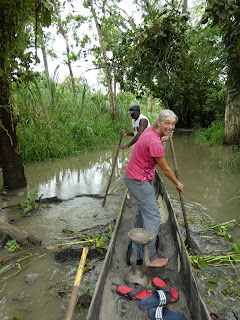
"It's no good, Tony. Water's coming in again at the front. I have to stop and bail." "Can't stop here! Waves are too big. Let's try going faster, get over to the far bank where the water's calmer." "No. NO! Stop paddling! STOP! It's coming in over the side now." "Shit. SHIT! Knew in Pagwi the waterline was too low. Can't even carry our bags on this frigging thing!" Nadya tosses her paddle aside and starts bailing feverishly with half a plastic Coca-Cola bottle, but it is too late. If only our pirogues were equal to those we bought in the Upper Sepik. Roped together, the two had formed a sturdy raft that could carry six people with bags, bananas, and coconuts. But in Pagwi, the hub of the Middle Sepik, there had been no choice. Most people got about by motor-canoe. We could only find for sale a two-man fishing pirogue in poor shape and another suitable for a five-year-old. Maybe if we joined these, we might cont...

A la source

Image
Ce matin, on est alle visiter une source thermale sur l'ile de Kairiru pres de Wewak. La source emane d'un rocher sur le bord de la plage. L'eau est suffisamment chaude pour y faire cuire un oeuf et c'est en plein ce qu'on a fait! On est parti de l'ile de Yuo avec notre hote, Tony, et ses trois jeunes freres King, Samuel et le petit Mark. 1er arret: la mission catholique St-John. Un vieux missionnaire de la Nouvelle Zelande nous a vendu des oeufs frais avec en prime une jasettes dans la chambre froide (quel bonheur! J'y serais reste l'avant-midi complet). 2e arret: un camp de base a la pointe ouest de l'ile. De la, on a emprunte un sentier pour se rendre dans la baie situee de l'autre cote de la pointe la ou se trouve la source thermale. La source emet des jets de vapeur et il y a une petite crevasse dans le roc just assez grande pour y deposer 1/2 douzaine d'oeufs. Avant de plonger nos oeufs dans le chaudron naturel, on les a enveloppes dan...

Day 7: Yanak, the Sorceror

Today, our paddlers are two brawny Papuans called Anton and Negatimus. I would like them to accompany us all the way to Kubkain, a full day's paddle away, but they don't wish to go that far. Our raft has become wider. They have tethered their pirogue to ours. When we arrive at Oum, in about five hours' time, they will detach it and paddle home. They expect to get home after dark, and Anton has brought along his crocodile catcher: a long bamboo spear with a barbed metal spike in the end. Crocs are abundant, he says, but nocturnal (we have only spotted one so far, a two-metre-long beast asleep on a mud-bank). A good hide sells for 500 kina, apparently. It is a tricky day for me. Yesterday, I drank too quickly from a creek feeding the Sepik, not allowing our "Pristine" purification tabs to do their work. Now I have diarrhea. From time to time, I have to strip down to my undies, make apologetic sounds, and slide off our plank into the river. Nadya captures my facial...